

An earlier version of this article appeared on July 11, 2017
Do you want to make a significant change in your life? Or help someone else to make an important change?
Often, this means changing a habit (get more sleep, quit sugar, exercise regularly, spend more time in nature, put down devices). Habits are like the invisible architecture of daily life — research suggests that about 40% of our existence is shaped by our habits.
In my book Better Than Before, I identify the 21 strategies that we can use to make or break our habits. Sometimes people get a bit freaked out that there are so many strategies to choose from—but it’s helpful that so many exist. Because some strategies work very well for some people, and not for others, and some strategies are available to us at certain times in our lives, but not at other times.
The most important point? There is no magic, one-size-fits-all solution to changing habits. It turns out that it’s not that hard to change your habits—when you do it in the way that’s right for you.
To change your habits, it’s crucial to identify your Tendency. My Four Tendencies framework divides people into four types based on how they respond to expectations — both outer expectations (from other people) and inner expectations (from themselves): Upholders, Questioners, Obligers, and Rebels.
Don’t know your Tendency? Take the quiz here.
Note: While many strategies work for just about everybody (Convenience, Inconvenience, Foundation, Clean Slate, Lightning Bolt), some strategies that work very well for one Tendency can actually be counter-productive for another.
Habit strategies for Upholders: Structure is your friend
Upholders readily meet both outer and inner expectations — which makes them well-suited to habit formation. Once they’ve decided to adopt a habit, they can generally stick with it. They appreciate rules, routines, and clear expectations, and they don’t like letting others down, including themselves.
What works for Upholders:
- Strategy of Scheduling (most important for Upholders)
The Strategy of Scheduling is a powerful tool for Upholders. They love to keep a schedule and march through every item. Whatever appears on the calendar—go to the gym on Monday and Thursday, write 1,000 words every day, goof off—gets done. They can make time for every person and activity they value, by putting it on the calendar.
- Strategy of Clarity
When Upholders know clearly what’s expected, they can generally meet that expectations. Very, very important to remember: Upholders can meet inner expectations, but only when those inner expectations are articulated.
- Strategy of Monitoring
Upholders do well with the Strategy of Monitoring, because they tend to love to-do lists with items to check off. Monitoring plays to this inclination: “I intend to walk 10,000 steps today, and look, my monitor says I hit that number.”
- Strategy of Pairing
Upholders can make good use of the Strategy of Pairing, because it’s easy for them to enforce the pairing rule on themselves. If an Upholder gets himself to go to the gym by pairing, “I can only shave on a day when I’ve gone to the gym,” he won’t have any trouble holding himself to that pairing.
What to watch out for:
Because Upholders can take advantage of just about every strategy, anyone who touts a scheme or device that’s meant to help people form good habits will have some success—because Upholders will tend to uphold, no matter what.
Habit strategies for Questioners: Get to your “why”
Questioners question all expectations and will meet an expectation only if they believe it makes sense. They resist anything arbitrary or inefficient, and they need reasons for everything they do. The good news: once a Questioner is convinced a habit is worth building, they can be very dedicated.
What works for Questioners:
- Strategy of Clarity (most important for Questioners)
The Strategy of Clarity is crucial for Questioners. They want to know exactly what they’re doing, and why. They won’t meet an expectation if they don’t understand the reason, so they must receive robust answers to their questions. They also must clearly see and trust the authority and expertise of the person asking them to meet that expectation.
- Strategy of Monitoring
The Strategy of Monitoring is a good fit for Questioners; Questioners’ love of data means they enjoy self-monitoring. They might wear a device to track the number of steps they take; use an app to track when they take their medication, or chart what time they go to bed.
- Strategy of Distinctions
The Strategy of Distinctions may resonate with Questioners, because it emphasizes that a habit should be tweaked very specifically to suit an individual’s character and idiosyncrasies—something that appeals to Questioners, who love customization. They can sometimes be convinced to try something “as an experiment.” “Why don’t you try this, you’ll find out if it works for you, and if not, you can try something else.”
What to watch out for:
A common stumbling block for Questioners is invoking loopholes to justify breaking a good habit. “I should exercise.” “But it’s too cold outside.” “Do my workout inside.” “But I have too much work and that takes precedence over exercise.” Learning to spot your own loopholes is one of the most valuable things a Questioner can do — because the arguments will always sound convincing.
Habit strategies for Obligers: Creating accountability
Obligers readily meet outer expectations but struggle to meet inner ones. They’re great team players and deeply responsible to others. But when it comes to goals that exist only for themselves, the motivation often stalls. This isn’t a character flaw, it’s just how Obligers are wired, and once you understand it, you can work with it.
- Strategy of Accountability (most important for Obligers)
All Four Tendencies (even, under certain circumstances, Rebels) find accountability to be useful for developing habits, but Obligers absolutely require structures of external accountability. They need oversight, deadlines, and consequences, and the involvement of accountability partners, such as coaches, accountability groups, trainers, health navigators, friends, or their own children. Obligers often feel a powerful sense of obligation to be good role models. They can often do something for someone else that they can’t do for themselves: “Once my baby was born, I had to quit smoking.”
- Strategy of Monitoring
Monitoring supports accountability, and the more Obligers monitor their behavior, the more easily accountability will attach.
- Strategy of Other People
Because of the weight imposed by outer expectations, Obligers—and the people around Obligers—must take careful note of the influence of other people, for good or ill.
- Strategy of Treats
All of us should use the Strategy of Treats; when we give more to ourselves, we can ask more from ourselves. Obligers, who give so much to others, need to replenish.
What to watch out for:
Obligers who don’t get enough back are vulnerable to Obliger-rebellion — a sudden, sometimes dramatic pushback when they feel burned out or exploited. Treats (which are different from rewards — a treat is something you give yourself just because, not as a prize for hitting a target) help prevent it. Remember: a treat is different from a reward. Rewards are very, very tricky to use correctly. Stick with treats.
Habit strategies for Rebels: You choose
Rebels resist both outer and inner expectations. They want to do what they want, in their own way, on their own time. Traditional habit advice — set a schedule, find an accountability partner, track your streak — is largely counterproductive.
What works for Rebels:
- Strategy of Identity (most important for Rebels)
For Rebels, the most effective habit-change strategy is the Strategy of Identity. Because Rebels place great value on being true to themselves, they can embrace a habit if they view it as a way to express their identity.
- Strategy of Clarity
The Strategy of Clarity works for Rebels, because it focuses on why a habit might have personal value for them. The more Rebels think about what they want, and why they want it, the more effectively they pursue it.
- Strategy of Convenience
Instead of trying to commit to scheduling a habit, Rebels often do habit-behaviors as soon as they feel like it.
- Strategy of Other People
The Strategy of Other People is also a useful strategy for Rebels to consider; Rebels love doing things differently from other people. They do an obscure kind of yoga, run barefoot, exercise late at night.
What to watch out for:
Rebels tend to resist if someone asks or tells them to do anything. It’s very important—but challenging—to avoid setting off their spirit of resistance. Also, many of the 21 strategies that work well for other Tendencies typically don’t work for Rebels: for instance, Strategies of Scheduling, Accountability, Monitoring, or Rewards.
More resources for changing habits
The right habit strategy isn’t the most popular one, or the one that worked for your friend. It’s the one that fits how you’re actually wired. Once you know your Tendency, that becomes a lot clearer.
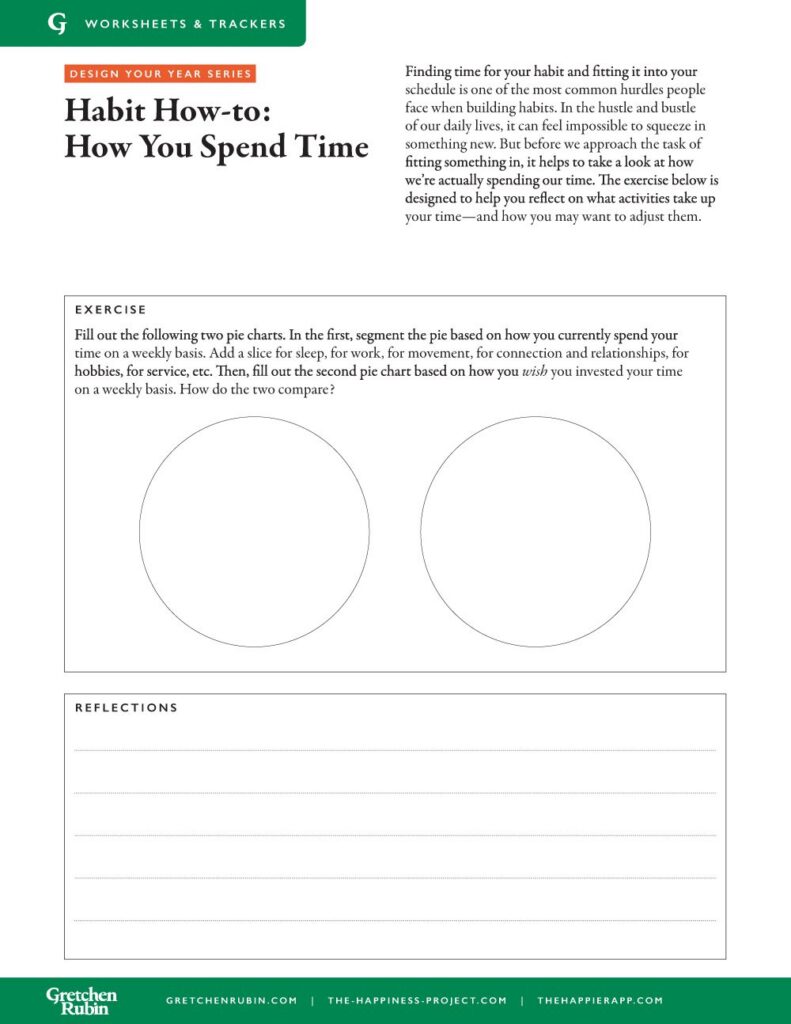
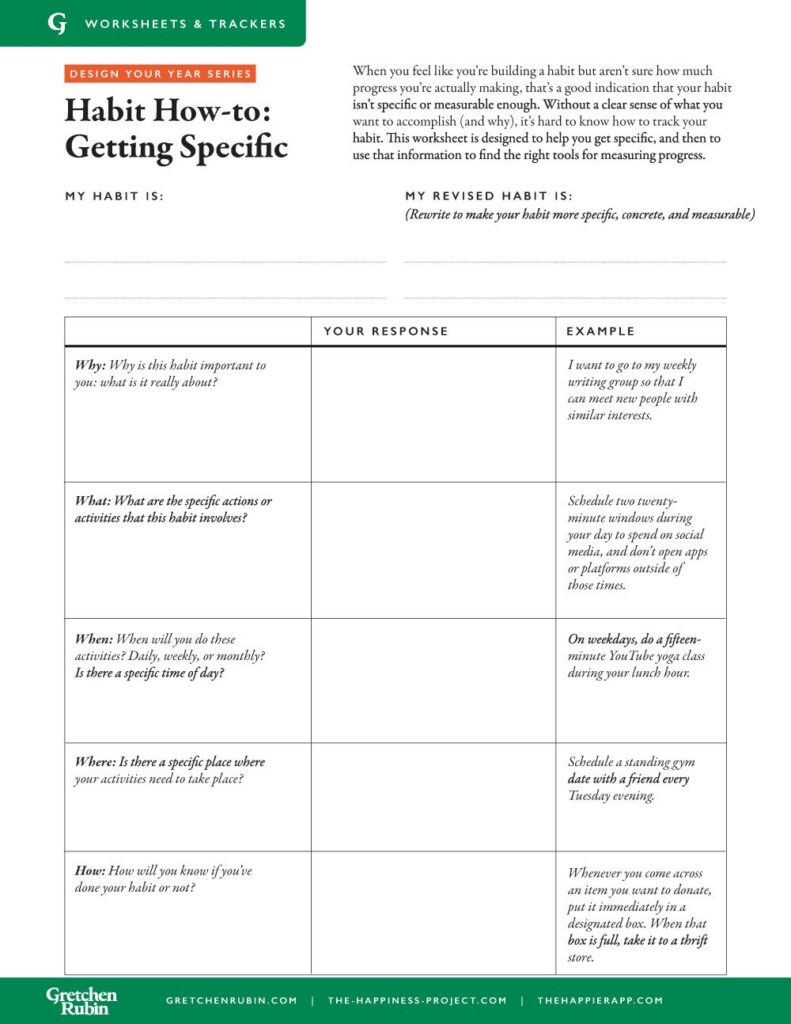
Next, spend some time planning. Try one of my free worksheets to help you find ways to identify which habits will bring you the most benefits and how to design them in a way that sticks.
From Better Than Before: The 21 Strategies for Habit Change
- The Four Tendencies (subject of my book The Four Tendencies)
- Distinctions (what works for other people may not work for you)
- Monitoring
- Foundation
- Scheduling (this is often counter-productive for Rebels)
- Accountability (Obligers! This is YOUR STRATEGY)
- First Steps (be on the look out for opportunities to harness this powerful strategy)
- Clean Slate (this strategy is powerful, but only available at certain times)
- Lightning Bolt (it’s frustrating–this is a strategy that happens to you; you can’t invoke it)
- Abstaining (this strategy works extremely well for some people, and not at all for others)
- Convenience (this is the most universal strategy)
- Inconvenience (twin of Convenience)
- Safeguards
- Loophole-Spotting (this strategy is hilarious to study)
- Distractions
- Reward (beware! this is a very, very tricky strategy to apply effectively)
- Treats (this is definitely the most fun strategy to follow)
- Pairing
- Clarity
- Identity (it took me a long time to realize the power of this strategy)
- Other People (never overlook this strategy)